
[vc_row][vc_column][vc_single_image source=”featured_image” img_size=”full” alignment=”center”][vc_column_text]When you’re at the thrilling juncture of designing an IoT or CPS device, you’ll inevitably confront the question of which communication module to choose. It all boils down to one simple factor: how much bandwidth do you need?
To paint a clearer picture, let’s use a straightforward analogy. Imagine standing in front of a glass of cool water. If you wanted to drink that water, would you use one straw or five? The difference between the two scenarios essentially represents bandwidth – how many “straws” you’re using to “sip” that information.
In the telecommunications, we come across two pivotal terms: Broadband (wide bandwidth) and Narrowband (narrow bandwidth). These refer to the volume of data and energy consumption our communication module will require.
Understanding the distinction between Broadband and Narrowband is crucial when determining which type of network connection will best cater to our needs. Knowing this helps us differentiate between a broadband connection, like the one we savor when binging our favorite shows on Netflix, and a narrowband one. In essence, while a narrowband frequency has a limited number of radio waves over a specific distance and time, broadband encompasses much more, allowing us, for instance, to enjoy a binge-watching spree.
The Bandwidth Duel: Broadband vs. Narrowband
Navigating the vast world of telecommunications can often feel like traversing a maze of technical jargon and intricate details. Yet, two terms frequently pop up and are sometimes misunderstood: broadband and narrowband. Let’s demystify these two key terms:
- Broadband Communication: Picture a multi-lane highway where each lane carries information. The more lanes available, the more data can flow simultaneously. Broadband operates similarly, transmitting data using a wide range of frequencies. This makes it the go-to choice for applications like high-speed internet and cable television, where efficient delivery of large data volumes is paramount.
- Narrowband Communication: Now, visualize a mountain trail—narrower, but more direct and dependable. That’s narrowband for you, focusing on a more limited range of frequencies. It might not be as swift as its broadband counterpart, but it’s reliable and perfect for applications that don’t demand tons of data. A prime example would be voice communications on our mobile phones.
Diving Deep with the Power Spectral Density (PSD)
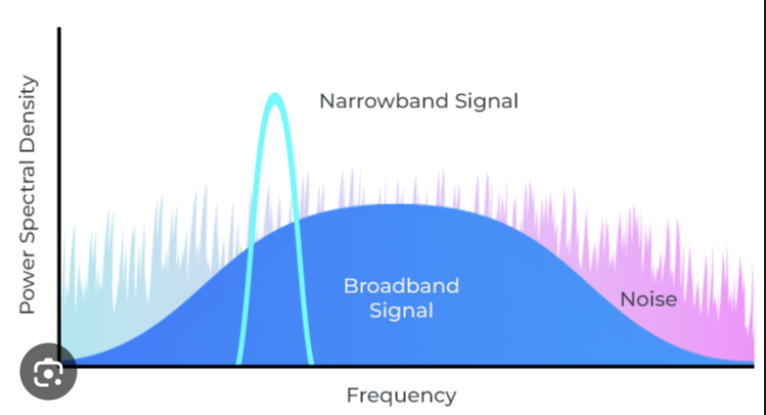
Imagine having a magical magnifying glass that could reveal how a song or any signal spreads its energy across different pitches or frequencies. That’s what the Power Spectral Density (PSD) is in signal analysis.
The PSD unveils the character of a signal—where it’s putting most of its energy. Picture a symphony with a strong, resonant note that stands out. Similarly, narrowband signals show a pronounced peak in their PSD at a particular frequency. It’s like these signals are saying, “Hey, I’m really focusing my energy here!”
On the contrary, wideband signals spread their energy more generously, without putting all their ‘eggs’ in one frequency ‘basket’. This difference in behavior is what distinguishes the ‘tightly-focused’ narrowband signals from their ‘all-over-the-place’ wideband cousins.
So, next time you think of signals, imagine them as musical compositions, each with its unique way of spreading melodies.
Types of Broadband
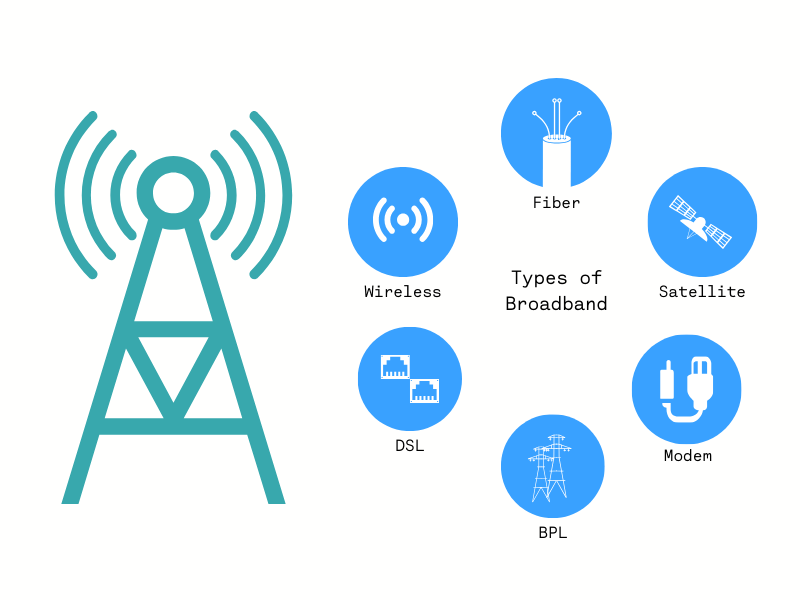
There are several broadband connection types for accessing the Internet:
- Fiber: Offers fast speeds using light cables.
- Wireless: Uses radio waves to connect devices without cables.
- Cable modem: Leverages TV lines.
- DSL (Digital Subscriber Line): Utilizes telephone lines for faster connections.
- BPL (Broadband over Power Line): Employs electrical lines.
- Satellite: Relies on orbiting satellites, especially for remote areas.
Each option has its advantages depending on location and needs.
Narrowband
“Narrowband” refers to a communication technology that utilizes a narrow range of frequencies to transmit data. This technology is characterized by having a lower data transfer capacity compared to broadband technologies, as well as reduced energy consumption. It’s associated with slower transmission speeds in comparison to broadband technologies.
Narrowband frequencies are often used for voice data transmission, especially in mobile radio systems. This is because the human voice occupies a relatively narrow frequency range, and narrowband communication systems are aptly suited to transmit voice data efficiently.
Frequency allocations for narrowband by regulatory bodies like the U.S. Federal Communications Commission (FCC) ensure that various services can coexist without causing interference. These allocations assist in organizing and regulating spectrum use effectively.
CAT-M (or LTE-M) and NB-IoT are examples of “narrowband” technologies. Both technologies use a narrow frequency range to transmit data and are designed to meet the needs of Internet of Things (IoT) devices that require efficient communication and prolonged battery life. Let’s not forget that we also have unlicensed bands like LoRa and SigFox.
Unraveling LTE-M and NB-IoT Modules for IoT
The rapid adoption of mobile broadband, as evidenced by data from Statista, underscores the need for efficient and advanced communication modules. As IoT solutions gain momentum, it’s imperative to understand the top options shaping the landscape:
- SARA-R5 Series:
- Origin: Built upon the u-blox chipset.
- Design Purpose: These modules are crafted for enduring performance in the IoT sphere.
- 5G Ready: Leveraging the UBX-R5 chipset from u-blox, they’re 5G-prepared.
- Key Features: Ensuring product longevity and unmatched support, these modules feature u-blox’s LTE and GNSS chipsets. This guarantees precise and trustworthy positioning courtesy of the u-blox M8 receiver and CloudLocate.
- nRF9160 SiP:
- Overview: A compact, integrated solution bringing advanced LTE tech within reach of diverse applications.
- Advantages: Global pre-certification makes it a boon for developers, addressing wireless design challenges and cellular tech qualifications.
- Specifications: This device melds an application processor, a multimode LTE-M/NB-IoT/GNSS modem, an RF frontend, and energy management in a compact 10x16x1.04 mm package.
- Ideal Use-cases: Especially suited for asset tracking applications, it supports GNSS and LTE location services. Noteworthy traits include its multimode LTE modem with certified LTE bands, and its compact LGA package. Furthermore, its ultra-low energy consumption optimizations make it economical and energy-efficient for end-to-end IoT communication via MQTT Anywhere and MQTT Flex.
- Quectel BC95-G:
- Nature: A multi-band IoT module known for its minimal energy requirements and sleek form factor.
- Distinctiveness: An integrated IoT communication solution, it supports various NB frequency bands, standing as an alternative to similar Low Power Wide Area Network (LPWAN) solutions like those provided by Sigfox and LoRa.
- Major Benefit: Its ability to harness widely-established cellular network infrastructures.
- Ideal Applications: Given its attributes, Quectel BC95-G is the go-to choice for diverse IoT applications. This spans smart metering, bike-sharing, smart parking, smart cities, asset tracking, household appliances, and even agricultural and environmental monitoring.
[/vc_column_text][/vc_column][/vc_row]